
Modern Parenting Does Not Scale
The fertility debate is missing the large-family problem.

Families with four or more children used to be ordinary in America.
Not exotic. Not a spectacle. Not a political statement. Just ordinary.
Today, they are rare enough to notice.
It is tempting to explain this by saying large families belonged to a different time, when women had fewer options, contraception was less available, and children were more essential for the household.
That is true to an extent. But it does not explain the whole change. Even in 1980, according to the Census Bureau’s historical fertility tables, roughly one in three women aged 40–44 had four or more children. Today, it is right around one in eight.
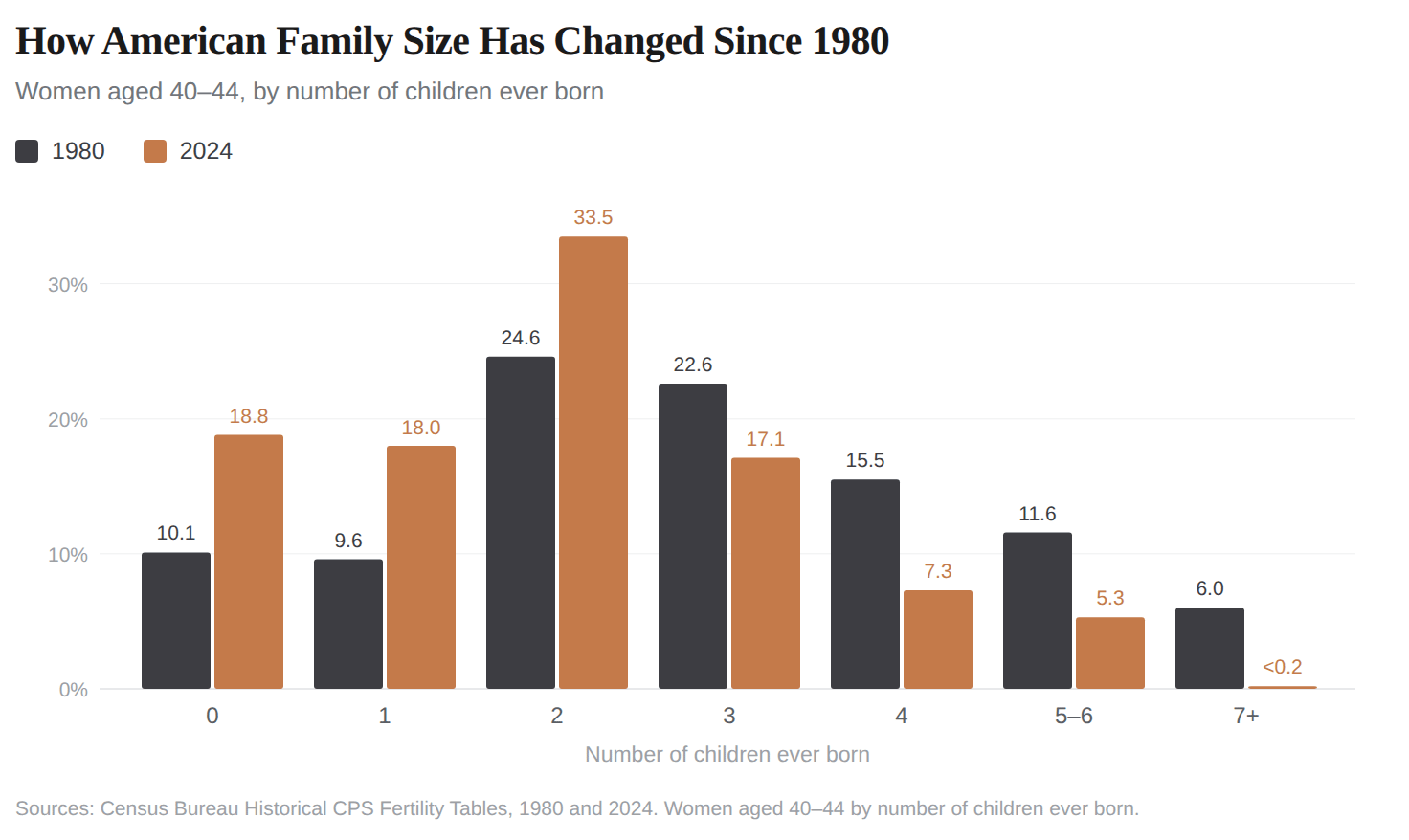
In just the past few decades, American family size has shifted downward, and the steepest losses are at the large-family end. Four-child families have decreased by more than half. Five and six-child families have fallen even further. Families with seven or more children have almost disappeared. Childlessness has grown too, but the graph’s most striking feature is the collapse of the large-family end of the distribution.
This disappearance of larger families is more recent than many people assume. It did not happen because America crossed from a pre-industrial culture into modernity. It happened because our modern society has, in a remarkably short span of time, been reorganized around the small family.
The fact that this change is so recent tells us that something in recent decades has broken.
I believe that the diagnosis is simple: modern parenting does not scale.
A system scales when it can grow without breaking down under the weight of complexity. Modern parenting often works the opposite way. Each additional child does not merely add one more place setting at the dinner table. It can push a family across hidden thresholds: the extra bedroom becomes a bigger house; the extra car seat becomes a larger vehicle; the childcare bill starts to feel like a second mortgage; the daily chores become not just constant, but unmanageable; the ordinary school calendar becomes a maze of schedules, activities, appointments, and expectations.
This system can usually make room for one child, and stretch to accommodate two. But the third child begins to strain the system, and by the fourth, the system often breaks. That is one reason the large family has collapsed in just the past few decades.
A society that wants larger families does not need to pressure everyone into having them. It needs to make them possible again for the people who already might want them.
That means asking a question the fertility debate does not ask clearly enough:
How do we help parents who want larger families but feel that they can’t?
The Missing “Right Tail”
A century ago, American families frequently had four, five, six, or more children. In 1910, according to the US Census, roughly half of women had at least four children. Well over a third had five or more. A family with six children was common enough that no one needed to explain it.
Statisticians might call these large families with four, five, six or more children, as the ‘right tail’ of the family size distribution. In America (and globally for that matter), this ‘right tail’ has collapsed in recent decades.
A society does not need every family to be large. But if almost everyone clusters at zero, one, or two children, with some families reaching three and very few going beyond that, it’s basically impossible for a society to have a sustainable overall fertility rate.
This reframes the problem away from just the common trope that modern people no longer want children. Often we focus on childlessness, delayed marriage, careerism, social isolation, and the collapse of family formation. And while much of that is real, it is not the whole story.
The 1940 Census is a useful reference point — not because it was a golden age of American fertility, but because it was the opposite. By 1940, birthrates had been falling for decades. The Depression had pushed fertility to what was then an all-time low. Childlessness was not just common — it was actually more prevalent than today: over 24 percent of women aged 40–44 had never had a child, compared to roughly 19 percent now.
Even at that historical low, nearly a third of women ages 40–44 had four or more children, and one in five had five or more. Fertility estimates from that era, despite being low, were still well above today’s levels. The completed-family-size distribution helps explain why: even with very high childlessness, the families with four, five, six, seven or more children compensated for the childless and small-family side of the distribution in a way they no longer do today.
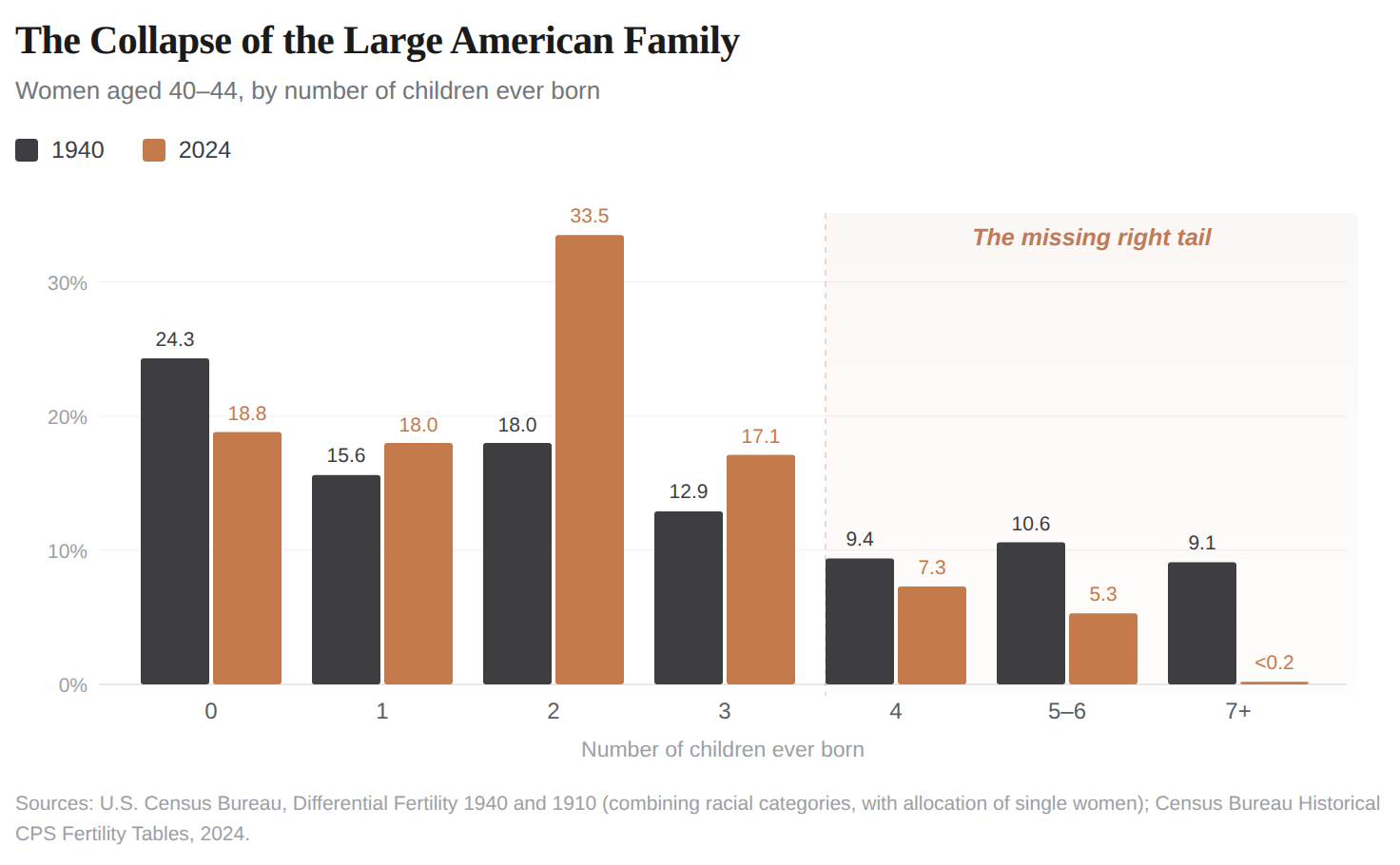
That is the missing right tail. Among women who become mothers today in America, the overwhelmingly common choice is to stop at one or two, and only occasionally three.
I use four or more children as the threshold for a large family because that is where the data tells the starkest story. But the scaling problem does not begin at four. In many ways, it begins at three. The same forces that helped eliminate the five, six, and seven-child family are now squeezing the four-child family, and increasingly the three-child family as well. These forces only compound: a society that cannot support four children today will struggle to support three tomorrow.
The fertility debate often asks how to reduce childlessness and help adults become parents. But we also need to ask how to help existing parents who want larger families but find that the modern system makes it feel unrealistic or impossible.
Earlier Family Formation Matters, But It Is Not Enough
Many argue that the key problem is that we are having children too late. And there is some truth to this — it is much easier to have a large family if marriage and first births happen earlier. A society where people routinely marry late, delay the first child into their thirties, and only begin thinking seriously about family after a decade of adult independence will naturally have fewer large families.
But earlier family formation is not the whole answer.
Even many families who begin in their early thirties could still have three or four children if they truly wanted to and if life made that realistic. The deeper question is why so many families who might have been open to a third or fourth child decide that it is simply too much. Earlier marriage and earlier first births certainly widen the window for larger families. But they do not solve the deeper problem: whether a household that wants to keep growing has the space, time, finances, support, and emotional capacity to welcome another child.
A Broken Parenting Model
The standard American parenting system is expensive, stressful, and difficult even before a family becomes large.
Tim Carney’s Family Unfriendly names this reality well: modern American family life — the homes, the cars, the work expectations, the schools, the childcare, the college assumptions — has all become difficult even for one child.
This modern system of parenting is often built around two full-time jobs, two cars, a mortgage, daycare and schools, extracurriculars, college savings, doctor and dentist appointments, birthday parties, playdates, and constant adult supervision. In this world, intensive investment in each child is the norm. Every child gets activities, enrichment, constant supervision, emotional monitoring, educational planning, and a long runway toward college. This system does not work well for a large family.
A parent cannot shuttle four children to four different extracurricular tracks every afternoon and evening without the household becoming a logistics company. The modern extracurricular world quietly assumes a small family: parents who can spend evenings driving, weekends at tournaments, summers arranging camps, and workdays adjusting around appointments. The college track makes the same assumption in financial form. A family cannot reasonably be expected to save separate college funds for four, five, or more children if every child is expected to follow the same expensive four-year path. And the workplace often makes the same assumption in time: that a mother can have a baby, take a short maternity leave, return to full-time employment, and then somehow repeat the process several times while also carrying the domestic life of a growing household. Something has to give.
Right now, what often gives is the third or fourth child.
What Larger Families Need
Solving this problem requires recognizing that large families are not just small families with extra children, but are a fundamentally different kind of household.
They require more shared space, and more hand-me-downs. More household production, sibling responsibility, and child independence. They also often need more informal care — whether that is help from grandparents, neighbors, friends, or communities. These children need more tolerance for imperfection, and less belief that every child needs a separate curated path through childhood.
Large families have always depended on a more communal and informal childhood. Older siblings helped younger siblings. Children played in groups. They learned to wait, to share, to take responsibility earlier. They were not treated as fragile individual projects requiring constant adult management.
An eight-year-old can set the table, fold laundry, vacuum the living room, or keep a toddler occupied while dinner is being made. A twelve-year-old can weed a garden, pack lunches, walk a younger sibling home, or clean up the kitchen after dinner. A teenager can cook dinner for the family, get younger children ready for bed, help with a family business, or watch the house for an afternoon. Children can walk places, play outside, solve minor conflicts, take responsibility, and contribute to the common good of the family.
This is not because large families need children to stop being children. It is because a large family is a real household, not a collection of individually managed childhoods happening under one roof. When children are allowed to become capable, the family has room to grow. When they are treated as fragile individual projects requiring constant adult management, every additional child becomes another schedule, another supervision burden, another life that must be curated from morning to night. That model may be barely possible with one or two children, but certainly not for four or five.
The modern world often treats the older pattern as suspect. We have become strangely uncomfortable with children being both independent and useful, but this is exactly what larger families need. Instead of trusting children with ordinary responsibility, our culture increasingly expects childhood to be supervised, enriched, scheduled, and entertained from morning to night.
Large Families Need a System That Works for Them
Large families cannot be sustained by parents simply trying harder. They need a way of life that actually works for them.
A household with three, four, five, or more children has different rhythms and different limits than the standard one or two-child family. It usually needs someone with real availability for the home — not necessarily always the mother, not necessarily full-time forever, but someone who is more present than modern life typically allows. Someone who can handle sick days, appointments, meals, laundry, toddlers, teenagers, and the daily work of holding a household together. The need does not stay the same as the family grows. With each child, there is more to notice, more to remember, more burdens to carry. At some point, this cannot be squeezed into the narrow margins of evenings, weekends, lunch breaks, and paid time off.
A culture that treats home-centered parenthood as a lesser calling should not be surprised when large families disappear. A mother at home with four young children is not doing nothing. She is doing work our society depends on but often refuses to count.
But even that is not enough by itself. Even the most dedicated parent at home cannot hold together what an entire community used to support.
Large families were never meant to be sustained by two isolated adults. They were sustained by a wider system: grandparents nearby, neighbors who knew each other, faith and community institutions, housing flexible enough to hold extended family, and an economy where a household could survive without both parents being fully consumed by paid work.
That system has been dismantled piece by piece. Extended families scattered. Housing became expensive. Zoning made multigenerational living harder. The stay-at-home parent became harder to afford and easier to dismiss. Neighborhoods became less communal. Children became more supervised and more isolated from the informal networks that used to absorb them.
Nobody had to pass a law saying large families are no longer welcome. We simply built a society where they barely fit.
What Would Actually Help
If the problem is cultural and structural, then the answer cannot only be one more tax credit.
While commonly advocated solutions like financial credits and paid leave policies can help a little, the deeper problem we need to tackle is making large family life normal and livable again.
This part of the fertility crisis may be more solvable than we think. Helping a stable family that wants more children move from two children to three, or from three to four, is a fundamentally different problem than convincing someone to have a first child. These are parents who already love family life. They already changed the diapers, upgraded the car, rearranged their careers, and built their lives around children. Many of them would welcome another child if the practical reality were not so daunting: the cost, the exhaustion, the house that’s too small, the help that isn’t nearby, and the isolation of becoming “a big family.”
These families need housing with both space and community — bedrooms, backyard cottages, grandparents nearby, zoning that does not make multigenerational life on your property illegal. They need childcare that goes beyond more institutional slots: support for direct parental care, relatives, co-ops, part-time help, arrangements that actually fit family life. They need workplaces that recognize children need parents long after infancy — not just during parental leave, but when they are ten, twelve, fifteen years old. They need an education system that does not demand every child follow the same expensive credentialing path, and financial-aid rules that recognize the reality of having multiple children in college1. And they need community: grandparents, neighbors, other families, people close enough to help before everything becomes an emergency.
None of this requires a strange new social experiment. Most of it is a return to normal human patterns. Government cannot manufacture all of it, but it can permit or obstruct it. Culture cannot be legislated into existence, but it can be honored and rebuilt.
Reopening Possibilities
While much focus has been spent worrying about childlessness, the unspoken problem hiding inside the fertility debate is that we have made it hard for families to grow. This is a much more solvable problem, if we name it correctly.
As a society we need to shift our focus towards the needs of the large family. This means clearing the obstacles we have created for full-time and home-centered parenthood, multigenerational households, communal neighborhoods, and mixed-age childhoods, and rebuilding a culture that accepts meaningful responsibility for children, doesn’t panic over credentials and extracurriculars, and welcomes large families back into the mainstream.
None of this was unusual even a few decades ago. Not long ago, large families were woven into ordinary American life, and we have spent several decades making them much harder to sustain. Now we have to decide whether we are willing to make room for them again.
Data note: The 1940 figures are drawn from the U.S. Census Bureau’s Differential Fertility, 1940 and 1910, using the tables on women aged 40–44 by number of children ever born. The original census reported these figures separately by racial category. I aggregated across racial categories, allocated non-responses and single women proportionally based on available distribution data, and combined child-count categories where needed to produce a comparable distribution. The modern comparison comes from the Census Bureau’s Historical CPS Fertility Table 2, “Percent Distribution of Women Age 40–50 by Number of Children Ever Born and Marital Status: Selected Years, 1970–2024,” using the 40–44 age bracket throughout.
The point is not false precision, but the unmistakable shape of the change: the dramatic decline in the right tail of the family-size distribution, especially among families with four or more children. Period fertility estimates and completed-family-size distributions are not the same measure, but they tell the same broad story: large families were still doing substantial demographic work in the earlier low-fertility period in a way they no longer do today.
Recent FAFSA changes are a revealing example. Under the FAFSA Simplification Act, the federal aid formula removed the number of family members in college from the eligibility calculation, replacing the old Expected Family Contribution framework with the Student Aid Index. In practical terms, this functionally eliminated what many families experienced as a “sibling discount” when they had multiple children enrolled in college at the same time.
So, I am someone who falls on one side of your tail (I don't and won't ever have children), however I live in one of the only places in the US that still is at least somewhat (though increasingly less so, year by year) built for large families, ie Utah, and I fully agree with your post.
However, and not to be a downer, but I think this is much more difficult to solve than you indicate. Because for one thing, these changes happened organically as families opted to invest more per child and have less of them in an increasingly competitive world...they were never imposed top down and the structural changes adapted to meet the realities moreso than the other way around. For instance, part of the reason colleges charge so much is because they can. If parents started to refuse to pay, they'd be forced to a drop their prices. But with more small families, and also a lot more RICH families nowadays (at least partly bc of less kids), there are simply enough parents out there willing and able to pay high prices, and wanting to do whatever they can to beat advantage their kids, that there is zero incentive for a university to drop its tuition. They will always charge as much as they can.
That's just one example but it runs to so many things. There are a lot of things in Utah that are clearly different than other places bc people still have, or at least aspire to have, bigger families. But the thing is, they kind of don't work when it's just a minority. It's really hard that way, just on basic economics.
Here's another example: there are a lot more shops and businesses here that are closed on Sundays and closed by 6 pm the other days, than most places in the US, where doing that would be business suicide. It used to be the norm, and now it isn't, and that's bc the vast majority of all adults, or the people who can actually patronize a business and spend money there, are at work M-F til 6. So if you're closed when they're out of work and can actually spend money, you're going to go out of business. This model only works in a place where you still have a critical mass of stay at home parents who can actually shop and buy things during the day. The reason a lot of shop owners want to be closed in the evenings and on Sundays is because they too have big families and they want to go home and be with them. Which makes perfect sense, for the the business owner, if there are enough local customers who can actually patronize your establishment during the weekdays. But if 80% of adults are at work, it doesn't work, and that business being closed in the evenings and on weekends is going to really annoy and piss off the working parents who can't ever go buy something at a shop bc they're always closed when they have actual free time.
There are so, so many little things like that. Kids still run outside and play everywhere here, without adult supervision. But that's bc there are enough kids to do that. Prices for kid-oriented stuff tend to be a lot lower here...again, because the market won't bear higher prices, since parents can't afford it when they have so many kids. If everyone had 1 or 2, and the parents had more cash, those businesses would of course jack their prices up, as they have everywhere else.
A lot of this stuff just ends up being the natural economic outcome of what happens when there are less kids and adults with more disposable cash, at a critical mass. So while I agree with your analysis, I'm not sure what the solution is other than just giving massive subsidies to large families, which would be quite difficult politically.
I suppose one point I'd raise it that it somewhat seems like a silly lost opportunity here, when you also DO have a lot more households with zero children. One would think that childless households would be an obvious source of extra support for parents precisely bc they usually DO have the extra time and money. And yet parents virtually never ask non-parents for help or favors, ever. I think this is bc they often have some distrust of childless people and/or maybe even a little hostility and/or assume they hate or dislike children. I think that's a shame and unnecessary and untrue, and that actually plenty of childless people would be more than willing to pitch in and watch a neighbor's kid or otherwise take a little burden off. They may not want or think they can handle a 24-7, 20-year commitment to kids, but that doesn't mean they aren't happy to help part time or in a pinch. And yet they are virtually never asked and almost assumed to live totally alien and separate lives and I think it's kind of dumb. Like just a silly misallocation where you have one group of people who are overwhelmed and another with excess capacity and no one ever thinks to shift that a bit, as between them, which would be the normal thing to do in most circumstances but it seems like some parents are afraid that non-parents are child hating baby eaters they can't trust or something. To be clear I think that is much more pronounced with men, where people do not want to tolerate the idea of an unrelated non-father ever spending time with a child bc they fear some kind of evil/perverse sexual thing, and is less an issue with women, but even there, I see a lot of excess wasted capacity.
My husband and I have 12 children (yep—all ours together). We basically decided to ignore “the system” and build our own family culture in spite of it. That has meant sometimes living in houses people would consider too small (even when we “only” had five children). I made the decision not to over-schedule our kids but to make sure we had opportunities to get together with other families at church and in the neighborhood to play, eat meals, and socialize. We lived overseas for eight years due to my husband’s work, and the last place we lived for five years was a tiny village in South Africa where the children could freely roam and where dozens of retirees taught classes—everything from piano to pottery to woodworking. It was an absolute boon for a big family—not paradise, but definitely far more supportive than the modern American town. When we returned to the US, we made the decision to move back to my husband’s hometown and buy a “fixer-upper” 1906 house in the oldest section of town…within walking distance of downtown and a local park. We have since finished out the back cottage for our older sons to live in while they continue to work and save, and we just added another small cottage for our oldest daughter. We are sticking to a nearly extinct model of family-building where everyone learns to pitch in and help each other succeed. Our second son married two years ago, and he and his wife chose to buy a house two blocks from us. They have the same vision of sticking together and helping one another—even if it’s just moral support and socialization. The oldest teens put together a business plan for a small coffee shop in 2020, since our downtown didn’t have one. They made it a school project, and Kickstarter raised the funds for it. We have since grown into a farm-to-fork bistro. One son is the chef, two others are baristas, two daughters bake and do clean-up. Large families really have to create their own job opportunities and educational options for their children without a societal support network backing them up. In this age of AI kicking people out of jobs, our children are all very motivated to “AI-proof” their lives and work with their hands and in service to others. I couldn’t be more proud of them. It has been a lot of very hard work, plus a lot of prayer and many sleepless nights, but the end results are so worth it. Kids don’t need iPads and endless entertainment—they need to feel needed. In a big family, we all need each other, and that is a beautiful thing. I am very thankful for parents who gave us the tools to do this…in spite of a massive cultural shift away from large families.